anúncios
Fortunately, learning how to stay flexible while traveling requires only targeted, low-impact movements tailored for aging joints.
Simple yoga routines protect your range of motion, relieve spinal compression, and preserve your energy throughout any journey.
Long-distance travel often turns dream vacations into physical endurance tests. Hours spent in cramped airplane seats, highway traffic, or train cars force the body into static postures.
For older adults, this motionless state triggers severe joint stiffness, muscle tightness, and sluggish circulation.
Índice
- Why Travel Triggers Severe Joint Stiffness in Older Adults
- How Seniors Can Practice Yoga Safely While On the Go
- Essential Seated Yoga Poses for Aircraft, Trains, and Automobiles
- Gentle Standing Poses for Rest Stops, Airport Gates, and Layovers
- Restorative Hotel Room Yoga for Recovery and Nighttime Sleep
- Daily Habits to Maintain Flexibility Throughout Your Trip
- Essential Travel Props to Pack for Senior Mobility
- Mindful Breathing Techniques to Manage Travel Anxiety and Tension
- Perguntas frequentes
Why Travel Triggers Severe Joint Stiffness in Older Adults
Aging joints undergo natural physiological changes over time. Cartilage hydration decreases, and the body produces less synovial fluid—the thick liquid that cushions joints and allows bones to glide smoothly past one another.
When an older adult remains seated in a constrained position for extended hours, synovial fluid settles and thickens.
This lack of fluid movement increases friction inside the knee, hip, and ankle joints, causing acute morning stiffness and painful stiffness upon standing.
Prolonged seated travel also keeps the hip flexors in a constantly shortened state. Tight hip flexors pull the pelvis forward, placing severe strain on the lumbar spine.
Meanwhile, the hamstring muscles along the back of the thighs tighten and shorten, aggravating lower back discomfort.
Reduced muscular contraction during long trips slows down lymphatic drainage and venous blood flow.
Fluid naturally pools in the lowest extremities due to gravity, leading to edema, ankle swelling, and deep leg fatigue.
| Travel Stressor | Anatomical Impact | Yoga and Mobility Solution |
| Static Prolonged Sitting | Thickens synovial fluid; causes acute knee and hip stiffness | Gentle joint rotations, ankle pumping, and seated hip openers |
| Compression of Lumbar Discs | Shortens hip flexors; increases lower spinal pressure | Seated Cat-Cow, spinal extensions, and lateral rib stretches |
| Restricted Blood & Lymph Flow | Causes lower extremity swelling; slows waste removal | Inversions like Legs-Up-The-Wall; standing calf stretches |

How Seniors Can Practice Yoga Safely While On the Go
Adapting yoga to unpredictable travel environments requires prioritizing balance, joint safety, and absolute simplicity.
You never need specialized athletic apparel or expensive studio equipment to maintain your physical mobility on the road.
Focus on stable, seated posture variations and supported standing movements that utilize your immediate surroundings.
Always move within a pain-free range of motion. Sharp discomfort, joint pinching, or tingling sensations indicate an immediate need to back off.
++ Os melhores estilos de ioga para idosos em 2026
Breathing smoothly through your nose during every pose stabilizes blood pressure, calms your central nervous system, and signals muscle tissues to relax safely.
Key Rules for Safe Senior Mobility:
Prioritize Stability: Always anchor yourself using airplane seats, sturdy hotel furniture, or solid walls.
Stay Pain-Free: Never force a joint or stretch beyond a comfortable, mild tension point.
Breathe Rhythmically: Maintain smooth, steady inhalations and exhalations through your nose.
Keep Sessions Short: Practice short 3- to 5-minute movement snacks every 2 hours during long travel legs.
Essential Seated Yoga Poses for Aircraft, Trains, and Automobiles
You can easily execute gentle yoga movements directly inside standard transportation seats without attracting unwanted attention or encroaching on neighboring passengers.
Seated Neck and Shoulder Unwinding
Sit upright with your spine long and shoulders relaxed down away from your ears. Drop your chin gently toward your chest.
Leia mais: Yoga para idosos que desejam mais equilíbrio e estabilidade.
Slowly tilt your right ear toward your right shoulder, keeping your left arm relaxed. Hold for three deep breaths to release tightness in the upper trapezius muscles and cervical spine. Repeat smoothly on the left side.
Chair Cat-Cow for Spinal Health
Place both feet flat on the floor, hip-width apart, with your palms resting on your knees.
Inhale as you lift your chest, arching your upper back slightly and drawing your shoulder blades together.
Exhale as you round your spine, tucking your chin and pulling your navel toward your backbone. Repeat this cycle 6 to 8 times to circulate synovial fluid throughout the spine.
Seated Figure-Four Hip Stretch
Ground your left foot firmly on the floor. Lift your right leg and place your right ankle across your left thigh, just above the knee joint.
++ Evite a queda de energia da tarde com meditação no local de trabalho.
Keep your right foot flexed to protect your knee. Sit tall and hinge forward slightly from your hips until you feel a gentle stretch in your outer hip and gluteal muscles. Hold for 30 seconds before switching sides.
Gentle Standing Poses for Rest Stops, Airport Gates, and Layovers
Airport gates, rest stop lawns, and train stations offer spacious environments where you can restore full-body circulation and decompress your spine.
Utilizing stable fixtures—such as sturdy airport seating, park benches, or heavy counter surfaces—provides crucial balance support.
Clinical research highlighted by the Institutos Nacionais de Saúde demonstrates that regular, low-impact exercise like yoga significantly improves postural balance, reduces fall risks, and preserves functional independence in older adults.
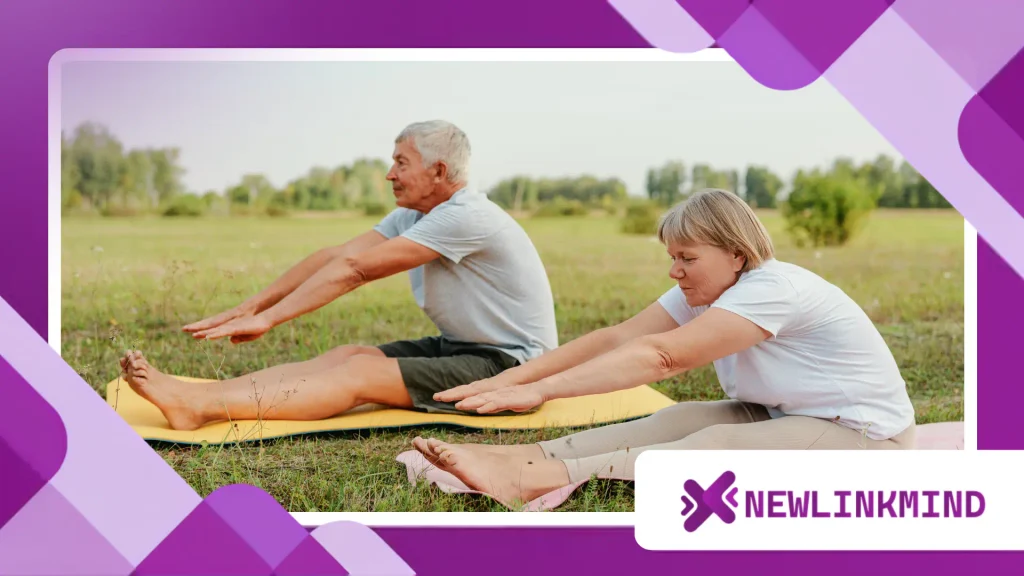
Standing Wall Downward-Facing Dog
Stand facing a wall about two feet away. Place your palms flat against the wall at chest height.
Walk your feet backward slowly until your arms extend fully and your torso aligns parallel to the floor, forming a gentle L-shape.
Press your hips away from the wall to stretch your hamstrings, shoulders, and entire lower back.
Supported Tree Pose for Balance and Hip Mobility
Stand alongside a sturdy wall or chair back, placing one hand on the surface for balance support. Shift your weight onto your inside leg.
Lift the heel of your outside leg, resting the foot against your opposite ankle like a kickstand.
Keep your hips level and breathe deeply for 5 slow breaths before turning around to repeat on the opposite leg.
Restorative Hotel Room Yoga for Recovery and Nighttime Sleep
Unfamiliar beds, altered daily schedules, and time zone shifts frequently disrupt sleep quality during travel.
Spending ten to fifteen minutes performing gentle restorative yoga in your hotel room eases physical tension and prepares your nervous system for deep rest.
Legs-Up-The-Wall Pose (Viparita Karani)
Lie flat on your back on your hotel bed or on a carpeted floor, bringing your hips as close to a clear wall as comfortable.
Extend your legs straight up against the wall, allowing your arms to rest open at your sides with palms facing upward.
Hold this passive inversion for 5 to 10 minutes. Elevating your legs above your heart uses gravity to drain accumulated fluid from swollen ankles, ease lower leg fatigue, and lower your resting heart rate.
Supported Bridge Pose
Lie on your back with your knees bent and feet flat on the mattress, hip-distance apart.
Lift your hips gently and slide a firm hotel bed pillow or folded bath towel underneath your sacrum (the flat bone at the base of your spine).
Lower your hips onto the prop and relax your arms. This gentle elevation opens tight hip flexors after a long day of sitting and relieves pressure across the lower back.
Reclined Spinal Twist
While lying on your back, hug your right knee gently toward your chest while keeping your left leg extended straight.
Guide your right knee across your torso over to the left side, allowing your right arm to extend out to the side like a T.
Keep both shoulder blades resting on the mattress. Take 5 long, slow breaths into your ribcage to release tension in your mid-back and lumbar region before switching sides.
Daily Habits to Maintain Flexibility Throughout Your Trip
Physical postures yield maximum benefits when integrated into a proactive travel routine. Small modifications throughout your journey prevent chronic muscle fatigue and keep your joint structures flexible.
Prioritize Hydration Continuously: Commercial airplane cabins maintain low humidity levels, which speeds up dehydration. Joint cartilage depends heavily on water to retain its cushioning properties. Drinking water consistently keeps joint tissues elastic.
Schedule Frequent Movement Breaks: Set a recurring timer on your watch or phone to stand up and walk for 2 to 3 minutes every hour during long flights or road trips.
Incorporate Micro-Stretches: Perform subtle movements such as ankle rolls, wrist circles, and gentle shoulder shrugs every 30 minutes while seated.
Maintain Lumbar Support: Place a rolled sweater, small travel pillow, or lumbar cushion behind your lower back during transit to support the spine’s natural curve.
Health guidelines published by the Centros de Controle e Prevenção de Doenças emphasize that staying physically active reduces chronic musculoskeletal pain and improves overall sleep quality—two critical factors for enjoyable travel experiences.
Essential Travel Props to Pack for Senior Mobility
Traveling light does not require leaving your physical support behind. Selecting lightweight, adaptable yoga props ensures you can modify exercises safely regardless of your destination.
Lightweight Travel Yoga Straps
A woven cotton or nylon yoga strap weighs almost nothing and takes up minimal space in carry-on luggage.
A strap extends your reach, allowing you to stretch tight hamstrings and shoulders without straining your back or overextending your joints.
If you forget to pack one, the fabric belt of a hotel bathrobe serves as an excellent temporary alternative.
Soft Foam Blocks and Foldable Mats
Compact, high-density foam blocks offer sturdy support during standing poses or seated elevation.
Additionally, thin foldable travel yoga mats fit easily into suitcases. They provide reliable traction on slippery hotel tiles or thin carpets, ensuring stable foot placement during your mobility routines.
Mindful Breathing Techniques to Manage Travel Anxiety and Tension
Terminal delays, long security lines, and dense crowds create psychological stress that manifests as physical muscle tension.
Connecting slow breathwork with subtle body movements calms the autonomic nervous system and keeps your body relaxed.
The 4-4-4-4 Box Breathing Method
Sit comfortably with an upright posture and relax your shoulders away from your ears:
- Inalar slowly through your nose for a count of 4 seconds.
- Segurar your breath gently for a count of 4 seconds.
- Expire smoothly through your mouth or nose for a count of 4 seconds.
- Pause and hold your lungs empty for a count of 4 seconds.
Repeating this four-step cycle 4 times reduces circulating stress hormones, relaxes muscle tension in the neck and jaw, and restores mental clarity during hectic travel days.
Perguntas frequentes
Can seniors practice yoga during long flights without leaving their seats?
Yes. Seated options like ankle circles, wrist rolls, gentle seated spinal twists, and chair cat-cow can be practiced discreetly in standard airplane seats to maintain circulation and joint flexibility.
How often should senior travelers stretch during a long journey?
Performing 2 to 5 minutes of gentle mobility work every one to two hours is optimal. Brief, frequent movement breaks prevent joint stiffness much more effectively than attempting one long stretching session at the end of the day.
Is yoga safe for seniors living with arthritis or joint replacements?
Gentle movement is highly beneficial for managing joint conditions. However, individuals with artificial joints or active arthritis flare-ups must avoid deep spinal twisting, extreme hip flexion, and aggressive stretching.
Always consult your doctor or physical therapist before traveling.
What is the most effective yoga pose for jet lag and swollen ankles?
Legs-Up-The-Wall (Viparita Karani) is widely considered the best recovery pose. Resting on your back with your legs extended up a wall uses gravity to drain fluid buildup in the lower legs, encouraging lymphatic return and restful sleep.
++ How to Keep Up Your Yoga Practice While Traveling
++ How to Practice Yoga While Traveling: 6 Tips for Every Practitioner