anúncios
When you want to build lower-body power, maintaining independence, confidence, and mobility as you age often comes down to this key physical attribute.
While strength allows you to lift or hold weight, power is the ability to exert force quickly. It is what helps you rise comfortably from a low chair, react fast enough to catch your balance after a trip, and climb stairs without hesitation.
You can effectively build lower-body power through targeted yoga practice right in the comfort of your living room, without needing heavy gym equipment or high-impact exercises.
Yoga is often associated with flexibility and relaxation, but specific standing and dynamic poses challenge the quadriceps, hamstrings, glutes, and calves in ways that build functional power.
By integrating intentional movement, steady resistance, and controlled transitions, older adults can strengthen their legs while protecting their joints.
Principais conclusões
- Power vs. Strength: Lower-body strength provides stability, but lower-body power supplies the quick force needed to prevent falls and perform daily movements smoothly.
- Accessible Home Practice: You do not need dynamic cardio or heavy weights; isometric holds combined with controlled dynamic transitions in yoga effectively activate fast-twitch muscle fibers.
- Safety First: Using household support like a sturdy chair or wall allows seniors to push their strength boundaries safely without fear of losing balance.
- Consistency Matters: Practicing a targeted 15-to-20-minute yoga routine three times a week yields noticeable improvements in leg power and balance.
Why Lower-Body Power Matters for Seniors
As adults age, muscle mass naturally declines—a process known as sarcopenia. However, muscle power declines at an even faster rate than static muscle strength.
Fast-twitch muscle fibers, which are responsible for quick bursts of force, are typically the first to atrophy without targeted exercise.
Losing lower-body power directly impacts functional freedom. It shows up when getting up from a deep couch requires pushing off with both arms, or when walking up a steep incline feels overwhelming.
More importantly, lower-body power plays a critical role in fall prevention.
When a foot slips or stumbles, the brain sends a rapid signal to the legs to step out and stabilize the body.
Without adequate power, the reaction time and muscle response may lag, increasing the risk of a fall.
Yoga addresses this need by combining muscular engagement with balance, proprioception, and spatial awareness.
According to physical activity guidelines from the Institutos Nacionais de Saúde, physical activity that combines balance, muscle strengthening, and moderate aerobic effort significantly improves functional abilities and reduces fall risks among older adults.
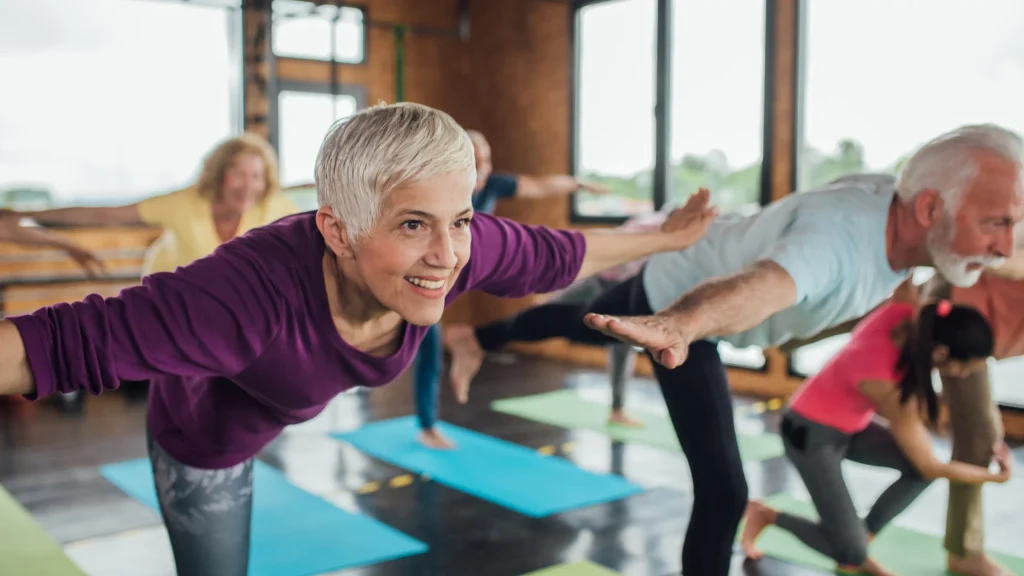
How Yoga Develops Muscle Power Without High Impact
Traditional power-building routines often rely on plyometrics—such as box jumps or squat jumps—which exert heavy strain on aging joints.
Yoga offers a joint-friendly alternative through controlled biomechanics.
Isometric resistance is the first key component. Poses like Chair Pose force the quadriceps and glutes to contract continuously against gravity. Holding these positions builds deep muscular endurance and foundation.
Dynamic transitions provide the next layer of power development.
Moving deliberately from one pose to another—such as stepping from a lunge into a standing balance—engages dynamic stability and trains muscles to generate force through movement.
Finally, grounding and foot engagement play a crucial role.
++ Apoie a memória episódica com ioga para idosos e movimento.
Yoga emphasizes pressing down through all four corners of the feet, activating the intrinsic muscles of the feet and calves that stabilize the ankle joint.
Essential Yoga Poses to Build Leg Strength and Power
Here are five effective, senior-friendly yoga poses designed to target the major muscle groups of the lower body.
Read here: Mantenha a flexibilidade durante as viagens com a prática de ioga para idosos.
For safety, perform these near a wall or have a solid, non-wheeled chair nearby for balance support.
Supported Chair Pose (Utkatasana)
Chair Pose is the gold standard for building strength in the quadriceps and glutes. To perform it, stand with feet hip-width apart, facing the back of a sturdy chair with hands resting gently on the top rail.
Inhale deeply, then exhale as you bend your knees and shift your hips back as if sitting down in an imaginary chair.
Keep your chest lifted and your weight centered in your heels. Hold for 3 to 5 deep breaths, then press firmly through your feet to stand back up.
++ Crie uma janela livre de telas com meditação matinal ao amanhecer, todos os dias.
To focus on power, emphasize the upward movement by pressing down through your heels and driving upward to a standing position with intent and control.
Guerreiro I (Virabhadrasana I)
Warrior I strengthens the front leg while stretching and stabilizing the hip flexor and calf of the back leg. Stand tall, then step your right foot back about 2 to 3 feet.
Turn your right foot out at a slight angle while keeping your left foot facing straight ahead. Bend your front left knee until it aligns over your ankle while keeping your hips facing forward.
Extend your arms upward or keep hands on your hips or a chair for balance. Hold for 4 to 6 breaths, then step forward and switch sides.
Focus your power on pressing down actively through the back heel while keeping the front thigh engaged.
Warrior II (Virabhadrasana II)
Warrior II targets the outer hips, glutes, and inner thighs, strengthening the lateral stabilizers of the lower body.
Stand with your feet wide apart. Turn your right foot out 90 degrees and your left foot slightly inward.
Bend your right knee until it rests over your right ankle. Extend your arms out to the sides at shoulder height, gazing over your right fingertips.
Hold for 30 seconds, maintaining a strong, steady core, then repeat on the opposite side. Drive power into the move by squeezing your glutes and actively pressing the floor away with both feet.
Tree Pose with Dynamic Lifts (Vrksasana)
Tree Pose improves balance, ankle stability, and single-leg strength. Stand tall near a wall or chair for balance support and shift your weight onto your left leg.
Place the sole of your right foot against your inner calf or ankle. Find a focal point on the wall ahead.
Once balanced, lightly lift off your right toe and press down into the standing left leg. Hold for 5 breaths, then switch legs.
To maximize power, continuously engage the standing calf and glute to maintain height and balance.
Goddess Pose (Utkata Konasana)
Goddess Pose builds strength in the inner thighs, glutes, and quadriceps while promoting hip mobility.
Step your feet wide apart and turn your toes outward at a 45-degree angle. Place your hands on your hips or at heart center.
Bend your knees deeply, tracking them over your toes, and sink your hips down into a wide squat while keeping your torso upright.
Hold for 3 to 5 breaths, then press firmly through your feet to return to standing. You can add small pulses at the bottom of the movement before pushing back up to standing to build extra power.
Sample 15-Minute Home Yoga Routine for Seniors
Integrating these poses into a regular weekly schedule is simple and straightforward.
You can structure your 15-minute home practice by moving through the sequence with clear focus on each pose’s distinct benefits.
Begin your routine with Supported Chair Pose to target the quadriceps, glutes, and calves. This movement directly supports the functional strength needed for rising from chairs.
Perform 3 holds of 5 breaths each. Next, move into Warrior I to work the quadriceps, hamstrings, and hip flexors, which develops forward movement power and balance over 4 to 6 breaths per side.
Transition into Warrior II to engage the glutes, abductors, and inner thighs for lateral stability and hip strength, holding for 4 to 6 breaths on each side.
Follow this with Tree Pose to focus on ankle stabilizers, calf strength, and the gluteus medius for single-leg balance and fall prevention, performing 5 breaths per leg across 2 sets.
Finally, conclude with Goddess Pose to target the adductors, quadriceps, and glutes for deep leg power, holding 3 times with optional pulses.
Safety Guidelines for At-Home Yoga Practice
Practicing at home requires a safe environment to prevent slipping or loss of balance. Always use a high-traction yoga mat on a level surface, and avoid practicing on loose rugs or smooth hardwood floors in socks.
Keep balance support nearby at all times. Position your mat next to a wall or heavy, non-wheeled chair. Using props is not a sign of weakness; it allows you to engage muscles safely and effectively.
Listen carefully to your joints throughout every movement. You should feel muscle activation and a mild burn, but never sharp joint pain in your knees, hips, or lower back.
If you experience joint discomfort, reduce your depth in the pose immediately. Take brief rest breaks between poses to catch your breath and maintain concentration.
For additional guidelines on physical activity safety for older adults, review recommendations provided by the Centros de Controle e Prevenção de Doenças, which outline safe movement strategies for older individuals.
Conclusão
Building lower-body power does not require heavy weightlifting or high-impact jumping exercises.
By committing to a simple, intentional yoga practice at home, seniors can effectively strengthen their legs, improve balance reaction times, and protect their functional independence.
To start, incorporate this 15-minute routine three days a week. Focus on clear form, strong breathing, and controlled movements.
Over time, you will notice greater ease when standing up, walking upright, and navigating your daily activities with confidence.
Perguntas frequentes
Is yoga enough to build leg muscle strength in seniors?
Yes, yoga provides effective bodyweight resistance. Poses like Chair Pose, Warrior II, and Goddess Pose require your leg muscles to support your body weight against gravity, which stimulates muscle fiber retention and builds functional strength.
How often should seniors practice yoga for lower-body power?
Practicing 3 to 4 times per week for 15 to 30 minutes yields consistent results. It allows enough stimulus for muscle development while providing adequate rest days for recovery.
Can I do yoga if I have knee osteoarthritis?
In many cases, yes. Building strength in the quadriceps and hamstrings through yoga helps take pressure off the knee joint.
However, you should modify the depth of your bends, avoid deep squats that trigger discomfort, and consult your physical therapist or healthcare provider before starting.
What is the difference between leg strength and leg power?
Leg strength is the total amount of force your legs can produce (e.g., holding a heavy object).
Leg power is how quickly your legs can produce force (e.g., catching yourself when slipping or pushing up rapidly from a low seat).
Power declines faster with age, making it essential to train intentional, responsive movements.
++ 8 Leg Strengthening Exercises for Seniors That Physical Therapists Recommend