廣告
Cultivating Deeper Self-Observation can help seniors better understand their thoughts, emotions, physical sensations, and everyday reactions.
As life changes with age, learning to pause and observe what happens internally can support greater emotional awareness and more intentional choices.
Meditation offers a practical way to develop this skill without requiring complicated techniques or long sessions.
By focusing attention on the present moment, older adults can recognize recurring patterns, respond rather than react, and develop a clearer, more compassionate relationship with themselves.
目錄
- Why does self-observation matter after 60?
- How does meditation strengthen awareness?
- What benefits does research support?
- How can seniors practice safely?
- Which meditation techniques work best?
- What does a practical weekly routine look like?
- 常問問題
- 結論
Why does self-observation matter after 60?
Aging brings transitions involving retirement, caregiving, relationships, mobility, finances, and identity.
experiences can trigger strong reactions, yet awareness creates space between an event and a response.
Cultivating Deeper Self-Observation trains attention toward present experience without requiring immediate judgment.
Rather than suppressing an uncomfortable thought, you learn to recognize it as a mental event that can be examined.
For seniors, that distinction can support deliberate choices.
Noticing tension before an argument, worry before a purchase, or fatigue before overexertion creates useful information for everyday self-management.
Importantly, self-observation does not mean constant self-analysis.
Healthy practice involves noticing sensations, thoughts, emotions, and impulses, then returning attention to the chosen object without turning observations into problems.
How does meditation strengthen awareness?
Focused-attention meditation asks practitioners to notice one anchor, such as breathing, and return whenever attention naturally wanders. Each return exercises attentional control.
Mindfulness adds a broader perspective by observing thoughts, sensations, and emotions as they arise.
You might notice, “My shoulders tightened when I heard that comment,” without immediately deciding what the comment means.
Over time, this process can reveal recurring patterns. Someone may discover that poor sleep increases irritability, skipped meals amplify anxiety, or certain conversations trigger predictable tension.
Cultivating Deeper Self-Observation can precede behavior change.
Meditation does not automatically eliminate a reaction; instead, it can make that reaction easier to recognize before it directs the next decision.
What benefits does research support?
Current evidence supports cautious optimism rather than sweeping promises. A 2024 meta-analysis of 46 studies involving older adults found modest overall benefits from mindfulness interventions.
The review reported significant effects for mental functioning, depression, sleep, anxiety, stress, and mindfulness, although researchers emphasized limitations.
Such findings support meditation as a complement, not a universal treatment.
Sleep deserves attention. A systematic review and meta-analysis of seven randomized trials involving 563 cognitively unimpaired older adults found improved sleep quality, while several cognitive outcomes did not significantly differ.
Anxiety research remains encouraging but limited. One systematic review identified seven randomized trials involving 355 older adults and found reduced anxiety symptoms after mindfulness-based interventions, while calling for stronger trials.
閱讀更多: 冥想如何幫助老年人拓展思維空間
These findings reinforce an important principle: meditation may improve awareness and responses to internal experiences, but evidence does not justify claims that it prevents dementia, reverses aging, or replaces medical care.
| Evidence area | Recent finding | Practical interpretation |
|---|---|---|
| Mindfulness and well-being | 46 studies; modest overall effect | Potential benefit, with meaningful variation |
| Sleep and cognition | 563 participants across seven trials | Sleep improved; several cognitive measures did not |
| Late-life anxiety | 7 trials; 355 participants | Anxiety symptoms decreased after intervention |
| Meditation and use | 17.3% of U.S. adults practiced meditation in 2022 | Meditation has become a mainstream wellness practice |
The National Center for Complementary and Integrative Health notes that meditation is generally considered safe, while also acknowledging that adverse experiences can occur and research on risks remains incomplete.
How can seniors practice safely?
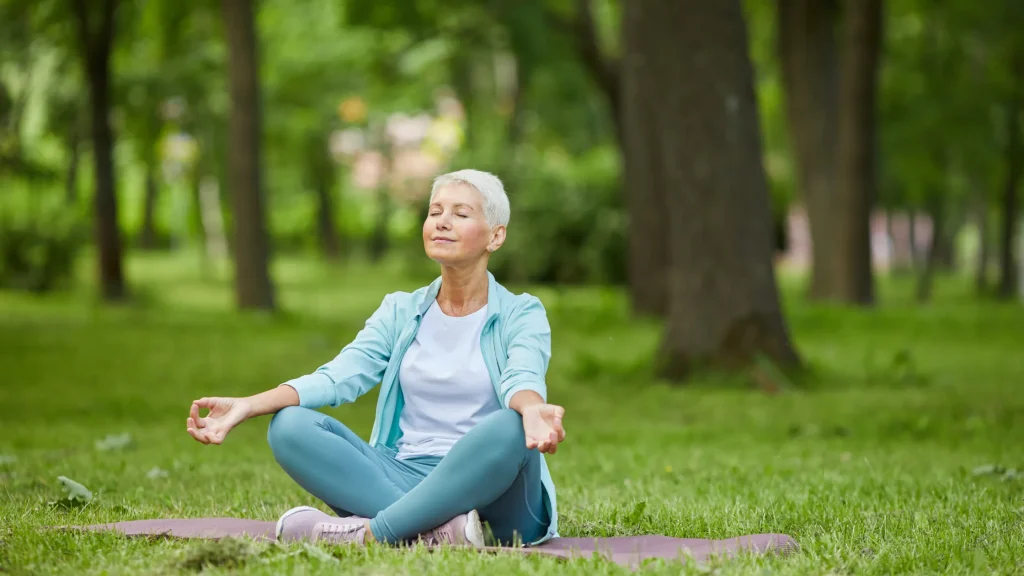
Start with five minutes rather than demanding a lengthy session. Sit comfortably, support the back if necessary, and choose a posture that does not create unnecessary strain.
Next, notice breathing naturally. When attention drifts toward memories, plans, sounds, or bodily discomfort, label the experience gently and return to breathing without criticizing yourself.
Another useful method involves a brief body scan. Move attention from the feet toward the head, noticing pressure, warmth, tightness, movement, or neutrality without trying to change each sensation.
Writing one sentence afterward can deepen learning: “I noticed worry when thinking about tomorrow.”
Notes help distinguish recurring patterns from isolated experiences and make meditation more personally relevant.
Consistency matters more than intensity. Practicing ten minutes most days may prove more sustainable than attempting forty-five minutes occasionally and abandoning the habit.
People with physical limitations can adapt posture, duration, and technique.
Anyone experiencing substantial distress or concerning symptoms should discuss meditation with a qualified healthcare professional. NCCIH: Meditation and Mindfulness — Effectiveness and Safety
Which meditation techniques work best?
Breath awareness suits beginners because breathing provides an accessible anchor that remains available almost everywhere.
Keep attention relaxed rather than forcing concentration or attempting to control every breath.
Body scanning works especially well when physical sensations carry useful information.
For example, noticing jaw tension before bedtime may encourage relaxation, while recognizing fatigue can support better pacing.
Open monitoring offers another approach. Instead of selecting one dominant object, observe thoughts, emotions, sounds, and sensations as they appear, while resisting the urge to follow each one.
Guided meditation can reduce uncertainty for beginners when memory, attention, or confidence makes independent practice difficult.
Choose reputable instruction and avoid programs promising guaranteed medical outcomes.
What does a practical weekly routine look like?
A realistic schedule for Cultivating Deeper Self-Observation might begin with five minutes of breathing on Monday, Wednesday, and Friday, followed by two minutes of written reflection after each session.
On Tuesday and Thursday, add a short body scan. During weekends, experiment with walking meditation and compare how each technique affects attention and willingness to pause before reacting.
Keep evaluation simple. Ask: What did I notice? What pattern appeared? Did it change what I did next? These questions turn meditation into observable practice.
Progress in Cultivating Deeper Self-Observation should not be measured by having an empty mind.
A productive session may contain frequent distractions because every moment of noticing provides another opportunity to practice awareness.
常問問題
Can meditation improve memory in older adults?
Evidence remains mixed. Recent research has not consistently demonstrated improvements across cognitive measures, so meditation should not be marketed as a proven memory-enhancement treatment or dementia prevention strategy.
How long should seniors meditate?
There is no universally established ideal duration. Beginners can start with five minutes and gradually extend sessions when comfortable, prioritizing regular practice, appropriate posture, and sustainable attention.
Is meditation safe for everyone?
Most healthy people can practice meditation safely, but some report unpleasant experiences. People with significant medical or psychiatric concerns should seek guidance before beginning.
Can meditation replace therapy or medication?
不。. Cultivating Deeper Self-Observation can complement evidence-based treatment, but it should not replace prescribed medication, psychotherapy, medical evaluation, or professional care for persistent symptoms.
結論
Cultivating Deeper Self-Observation becomes valuable when meditation moves beyond relaxation and develops a practical capacity to notice internal signals before they shape behavior.
For older adults, that skill can support emotional regulation, thoughtful decision-making, sleep routines, and clearer recognition of personal patterns.
Research suggests modest benefits, while important limitations remain.
Begin with five quiet minutes, choose one technique, and record what you notice. Revisit observations weekly, looking for patterns rather than judging sessions.
Above all, treat meditation as training, not a performance. Your goal is not to achieve perfect stillness; it is to become more familiar with how attention, thought, emotion, and sensation interact.
For trustworthy guidance on meditation, safety, and complementary health approaches, consult the National Center for Complementary and Integrative Health’s evidence-based resources. NCCIH: Psychological and Physical Practices for Older Adults
++ Emotional Self-Care Ideas for Seniors Using Meditation and Mindfulness