
How Workplace Meditation Boosts Focus and Productivity

advertisements
Work can be loud — even when it’s quiet. Notifications ping. Messages stack up. Someone asks for “just a minute,” but your brain is already juggling five things. At some point, focus starts to fade.
Workplace meditation isn’t a trend. It’s a response to this mental overload. A way to clear the static and reconnect with what you’re actually doing.
It’s not about emptying your mind or escaping responsibility. It’s about learning to return — to your breath, your task, and your own attention. And that simple act, repeated daily, changes everything.
What Happens When You Meditate at Work?
Meditation doesn’t turn you into someone else. It helps you come back to yourself. And in the middle of a hectic workday, that’s powerful.
When you pause, even briefly, your nervous system begins to shift. Your breath slows. Your thoughts stop racing. And that stillness, even if it lasts only a few moments, gives your mind space to organize.
advertisements
It’s like putting down a pile of books you’ve been carrying. They’re still there. But now you can sort them, one by one.
Meditation at work helps reduce reactivity. You stop snapping at emails, stop zoning out in meetings and listen better. Think more clearly. Respond with intention, not urgency.
Real People, Real Shifts
Leticia works in customer support. Her mornings used to start with a full inbox and rising anxiety. Then she started a short meditation before logging in. Just five minutes. No phone. No distractions.
advertisements
Now, she says her responses feel calmer. Her tone is more thoughtful. And surprisingly, she finishes tasks faster — not because she’s rushing, but because her focus holds.
Lucas, a marketing director, created a “mindful minute” rule before presentations. One full minute of silence, breath, and no movement. At first, it felt awkward. Now, he says it sharpens his delivery. He walks into meetings feeling steady, not scattered.
It’s not about doing more. It’s about doing with presence. These aren’t productivity hacks. They’re practices of self-respect.
Read also: Relaxing Sound Playlists for Morning Meditation
Why Focus Improves When You Stop
We tend to associate productivity with movement — ticking off tasks, answering faster, multitasking. But the brain doesn’t work best that way.
It works best when it has rhythm. Activity and rest. Input and silence.
When you skip the silence, your attention gets pulled in every direction. You react instead of responding. And focus? It dissolves.
According to a report from the Harvard Business Review, workers spend nearly 47% of their day thinking about something other than what they’re doing. That’s nearly half the day spent in distraction.
Meditation helps bring the mind back to the moment. Back to the email you’re writing. The call you’re about to join. The project that needs your full presence.
And from that place, decisions come easier. Ideas feel clearer. Work gets done — with less friction.
Meditation Doesn’t Take Time. It Creates It.
“I don’t have time” is the most common reason people avoid meditation. But what if time isn’t the problem?
What if the real issue is mental congestion — too many tabs open, all the time?
Workplace meditation doesn’t take time. It creates it. It gives you five minutes of clear thought that might save you twenty minutes of rework later.
Think of it like closing background apps on your phone. It runs smoother. Battery lasts longer. Same with your mind.
Ten minutes of breath might sound like a pause. But in the flow of your day, it might be the thing that moves everything forward.
What Workplace Meditation Looks Like
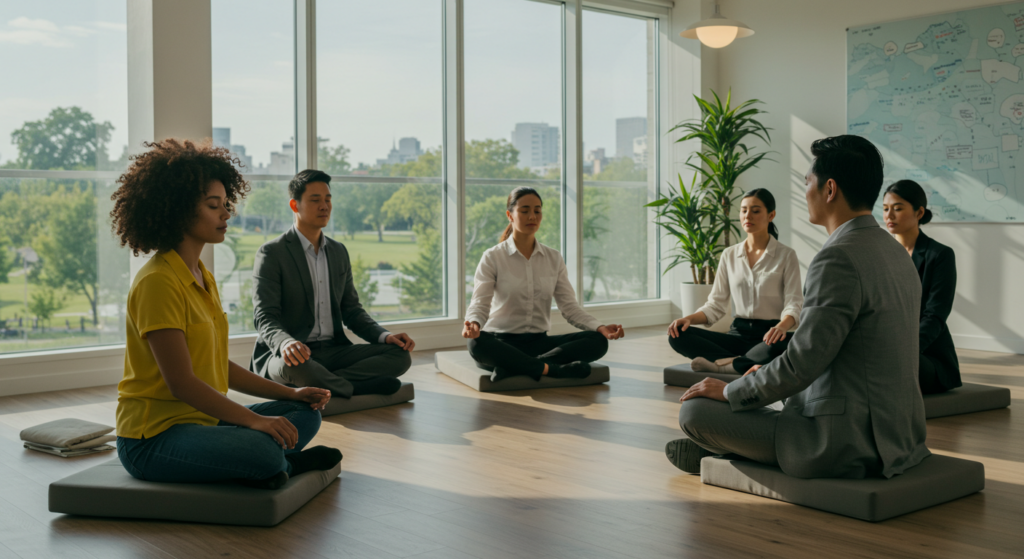
You just need a pocket of stillness. And a willingness to be there.
Close your laptop. Turn away from the screen. Place your hands on your lap. Breathe in. Breathe out. Stay there.
Some use apps like Headspace or Calm. Others set a silent timer. Some just follow the rhythm of their own breath.
You can meditate:
- Before starting your day
- Between meetings
- After a stressful conversation
- When you feel overwhelmed
- Or just because you remembered to
You don’t need to feel a certain way to begin. The practice meets you where you are. Every time.
Resistance is Normal — and It Passes
At first, meditation at work might feel strange. You might feel guilty for stopping. Or restless. Or impatient.
That’s part of it.
Sitting in stillness isn’t always peaceful. Sometimes, it brings up discomfort. But staying with it teaches you something. It shows you that you don’t have to follow every thought.
That calm doesn’t come from controlling your environment — it comes from being able to return to yourself, no matter the environment.
And over time, that changes how you show up at work. You begin to carry that calm into your next task. Your next conversation. Your next challenge.
You’re Not Lazy — You’re Overstimulated
We often confuse mental fatigue with laziness. But most of the time, you’re not lazy. You’re just tired of switching gears constantly.
Meditation doesn’t fix everything. But it creates a pause long enough for your system to catch up. For your attention to land. For your mind to breathe.
When the nervous system relaxes, clarity returns. Not because you tried harder — but because you gave space.
What would your workday look like if you gave yourself permission to stop — just for five minutes — and listen to the silence behind the noise?
Gentle Answers About Workplace Meditation
Can I meditate at work without looking awkward?
Yes. Eyes closed, steady breath, even for two minutes — that’s enough. You don’t need to sit cross-legged or make a show of it.
Do I need a private space to meditate?
Not necessarily. Even a quiet corner, parked car, or headphones at your desk can work. Privacy helps, but isn’t required.
Will meditation really help with deadlines and pressure?
It won’t remove the pressure, but it changes how you relate to it. You feel more centered, which makes action clearer.
What if I get interrupted while meditating?
That’s okay. Notice the interruption, take a breath, and start again if you can. There’s no perfect session — only practice.
Is it okay to use an app during meditation?
Absolutely. Apps can guide you, especially if your mind feels too scattered to go it alone. Use what supports you.