publicités
Challenge lower-body power every time you rise from a low armchair, climb a flight of stairs, or catch your balance on an uneven sidewalk—daily movements that require more than basic flexibility.
They demand the ability of your leg muscles to generate force quickly and steadily.
You do not need heavy dumbbells or gym machines to build that resilience, because you can train effectively using nothing more than gravity, controlled movement, and your own body weight.
Points clés à retenir
- Power differs from pure strength: While strength is how much force a muscle can produce, power is how fast you can apply that force to rise, step, or stabilize yourself.
- Tempo builds explosive control: Moving quickly into a yoga pose and lowering slowly turns classic bodyweight postures into effective lower-body power drills.
- No equipment required: Standing poses like Chair Pose, Warrior II, and Goddess Pose overload the quadriceps, glutes, and calves safely without external weights.
- Joint-friendly progression: Using a sturdy wall or chair for balance lets older adults focus on leg drive and muscle recruitment without risking a fall.
Why Lower-Body Power Matters More Than You Think After 60
Most fitness conversations for older adults focus on balance, gentle stretching, or basic endurance.
While those qualities are essential, exercise physiologists consistently note that muscular power declines faster with age than maximal strength.
According to the National Institute on Aging (NIA), maintaining muscle strength and power through regular physical activity is critical for preserving mobility and independence in later life.
Think about everyday movements that keep you active and independent:
- Rising smoothly from a seated position without pushing off the armrests.
- Stepping briskly onto a curb or up a flight of stairs.
- Recovering your footing quickly if you trip over a rug or uneven pavement.
Each of these actions relies on fast-twitch muscle fibers in your quadriceps, hamstrings, glutes, and calves.
When you train your legs to produce force efficiently, daily tasks feel lighter, and your reaction time improves when your balance is challenged.
How Can Yoga Build Lower-Body Power Without Weights?
Traditional yoga often emphasizes holding static poses for several slow breaths.
++ Utilisez des blocs de mouvement courts en yoga pour les seniors afin de renforcer leurs muscles.
While isometric holds build muscular endurance and joint stability, you can modify how you enter and exit poses to target lower-body power without adding dumbbells or resistance bands.
1. Dynamic Tempo Shifts (Fast Up, Slow Down)
The secret to bodyweight power training lies in movement speed. Instead of drifting casually from one posture to the next, practice driving upward with crisp, controlled energy, then lowering back down over three to four slow counts.
Lire ici : Utilisez des enchaînements par intervalles en yoga pour seniors afin d'améliorer votre endurance.
That deliberate contrast recruits both fast-twitch and slow-twitch muscle fibers while protecting your knees and hips from jarring impact.
2. Longer Leverages and Deeper Angles
You do not need external weights when you can adjust leverage. Widening your stance in a lunge or sinking two inches deeper into a squat immediately increases the mechanical load on your thighs and glutes.
Even small shifts in posture force your lower body to work harder against gravity.
3. Single-Leg Stability Challenges
Everyday walking and stair climbing happen one leg at a time.
Transitioning smoothly from a two-legged stance onto a single supporting leg trains your hip stabilizers and ankle muscles to fire rapidly, building functional power where you need it most.
5 Yoga Poses That Challenge Lower-Body Power for Seniors
Before starting any new exercise routine, especially if you have arthritis, osteoporosis, or recent joint replacements, consult a healthcare provider or physical therapist.
Always keep a sturdy, non-rolling chair or clear wall within arm’s reach for support.
1. Dynamic Chair Pose (Utkatasana)
Chair Pose is the gold standard for functional leg power because it directly mimics sitting down and standing up.
Stand with your feet hip-width apart and your heels a few inches in front of a sturdy chair.
Inhale, hinge at your hips, and bend your knees as if reaching your hips back toward the seat, raising your arms forward to shoulder height.
Hover just above the chair for one full breath, keeping your weight in your heels and your chest lifted.
Exhale and press firmly through your heels to stand up briskly and smoothly.
++ Essayez la pleine conscience les yeux ouverts pendant votre méditation matinale à la maison
Repeat 6 to 8 times, taking 3 seconds to lower down and 1 second to rise.
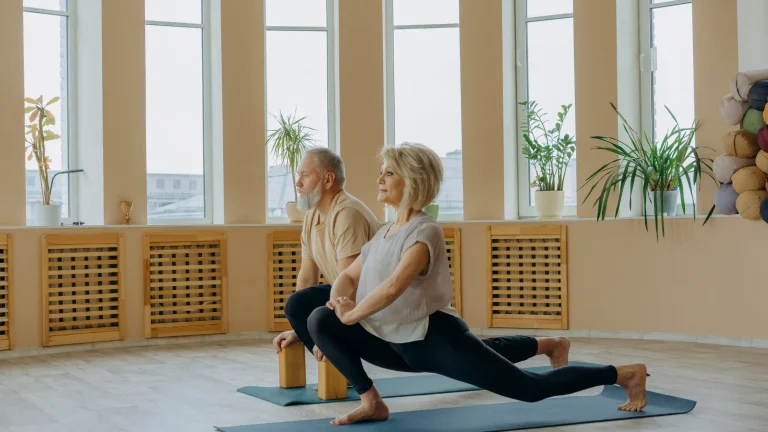
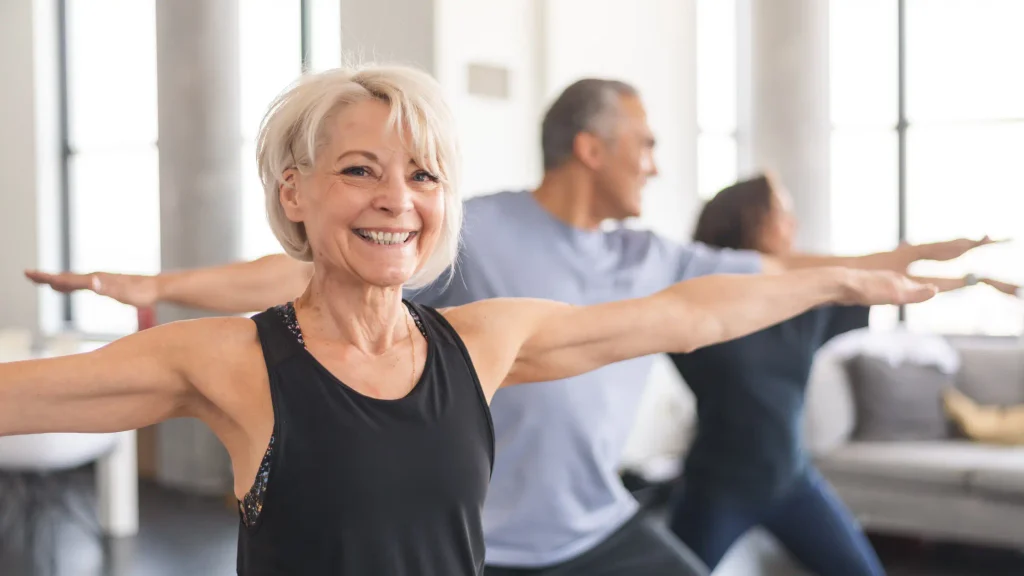
2. Warrior II Pulse to Extension (Virabhadrasana II)
Warrior II builds deep endurance in the quadriceps and inner thighs, while adding a controlled pulse introduces a power component.
Step your feet wide apart, turning your right toes toward the front of your mat and your left foot slightly inward.
Bend your right knee directly over your right ankle until your thigh feels engaged, extending your arms out to a T.
Press strongly through your right heel to straighten your front leg briskly on an exhale.
Inhale and lower back into the bent-knee lunge over 3 slow counts.
Complete 5 to 6 repetitions before switching sides.
3. High Lunge Heel Raises (Alanasana Variation)
Strong calves and ankles are essential for walking speed and tripping recovery. Adding a heel lift to a supported High Lunge targets the lower leg directly.
Stand facing the back of a sturdy chair with your hands resting lightly on the top rail.
Step your right foot forward and your left foot back, keeping your back heel lifted and both knees slightly bent.
Inhale to sink slightly into both knees, loading your front thigh and glute.
Exhale and press up onto the ball of your front foot, lifting your front heel an inch or two off the floor with control.
Lower the heel slowly and repeat 6 to 8 times per side.
4. Goddess Squat with Brisk Rise (Utkata Konasana)
Goddess Pose targets the glutes, adductors, and outer hips—muscles that keep your pelvis level when you walk.
Stand with your feet wider than hip-width apart and your toes pointed outward at roughly 45 degrees.
Keep your torso upright as you bend your knees, tracking them in line with your middle toes.
Pause at the bottom of your comfortable range for two seconds without letting your knees collapse inward.
Drive through both heels to stand tall with crisp energy, squeezing your glutes at the top.
Perform 6 to 8 slow-lowering, brisk-rising repetitions.
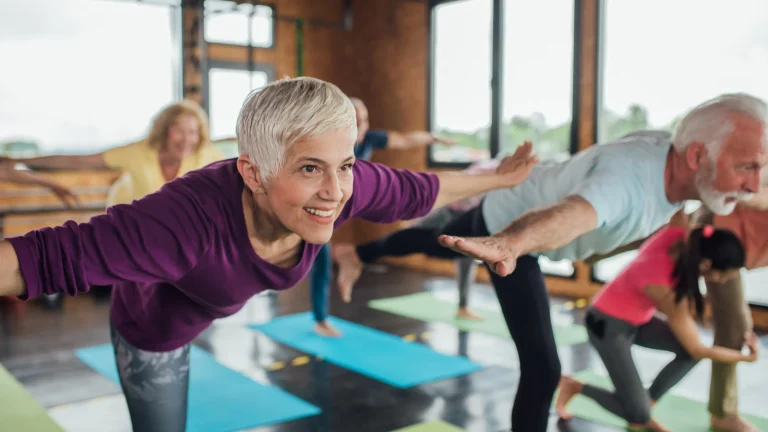
5. Warrior III Tap-Backs (Virabhadrasana III Prep)
Stand behind a sturdy chair, resting both hands lightly on the backrest.
Shift your weight onto your left leg with a soft bend in the knee.
Hinge forward slightly at your hips while tapping your right toes gently on the floor behind you.
Exhale and use your left glute and hamstring to pull your torso upright briskly, bringing your right foot back beside your left.
Complete 5 to 6 controlled repetitions on each leg.
Comparison of Lower-Body Power Yoga Poses
The table below outlines which muscles each posture targets and how to modify the movement for your current comfort level.
| Posture de yoga | Primary Muscles Worked | Power Cue | Simple Modification |
| Dynamic Chair Pose | Quadriceps, glutes, core | Lower for 3 seconds; stand up briskly in 1 second | Tap hips lightly to a chair seat before standing |
| Warrior II Pulse | Front quadriceps, inner thighs, glutes | Press through the front heel to straighten smoothly | Shorten your stance and bend the front knee less deeply |
| High Lunge Heel Raise | Calves, ankles, quadriceps, hip flexors | Lift the front heel decisively while keeping hips steady | Hold a wall or chair back with both hands for balance |
| Goddess Squat | Glutes, adductors, outer hips | Drive through both heels to stand tall without locking knees | Keep your squat shallow and hold a chair in front of you |
| Warrior III Tap-Back | Hamstrings, glutes, ankle stabilizers | Pull back to standing using the standing hip and glute | Keep your back toes resting lightly on the floor throughout |
Safety Tips for Power-Focused Senior Yoga
Moving with brisk intent does not mean rushing or losing form.
According to the Centers for Disease Control and Prevention (CDC), older adults benefit most from multicomponent physical activity that combines balance training, aerobic movement, and muscle-strengthening exercises performed safely.
Keep these three guidelines in mind during every session:
Prioritize knee alignment: Always guide your knees in the same direction as your middle toes. If you feel sharp pain in a knee or hip joint, shorten your stance or reduce how deeply you bend.
Breathe through the effort: Never hold your breath when pressing up from a squat or lunge. Exhale during the brisk upward drive to keep your blood pressure steady and your core engaged.
Start with two sessions per week: Power training taxes your nervous system and muscle fibers differently than gentle stretching.
Allow at least 48 hours of rest between power-focused yoga sessions so your muscles can recover and adapt.
Conclusion
Building explosive, reliable leg strength after 60 does not require a gym membership or heavy equipment.
When you pair classic standing postures with intentional tempo shifts—lowering slowly and rising with crisp control—you can effectively challenge lower-body power with yoga for seniors while protecting your joints.
Start today by practicing two sets of six Dynamic Chair Poses using a sturdy kitchen chair, focusing on smooth control on the way down and steady, confident drive on the way up.
Foire aux questions
Can seniors really build leg power without lifting weights?
Yes. When you move your own body weight against gravity with intentional speed—such as rising briskly from a squat or lunge after lowering slowly—you stimulate fast-twitch muscle fibers and improve neuromuscular coordination without external loads.
How often should older adults do power-focused yoga?
Aim for two non-consecutive days per week, lasting 15 to 25 minutes per session. Spacing sessions at least 48 hours apart gives your muscles and tendons adequate recovery time while still allowing steady progress.
Is power yoga safe if I have knee arthritis?
Controlled, low-impact power movements can actually support arthritic knees by strengthening the surrounding quadriceps and glutes.
Avoid jumping or deep knee flexion, keep your movements pain-free, and use a chair or wall for support while checking with your doctor or physical therapist first.
What is the difference between gentle yoga and power-focused yoga for seniors?
Gentle yoga primarily uses long, passive stretches and slow transitions to improve flexibility and relaxation.
Power-focused yoga for seniors stays completely low-impact, but uses active standing postures and brisk upward movements to train muscle responsiveness and functional strength.
++ Yoga For Seniors – Gentle Yoga Classes To Improve Your Quality of Life
++ No weights – just 30 minutes of yoga-inspired strength exercises for the whole body