anuncios
A make micro-recovery possible, you have to rethink how you handle back-to-back video calls, constant Slack notifications, and tight deadlines that leave very little room for a traditional 30-minute break.
When mental fatigue builds up over an eight-hour workday, trying to push through usually leads to slower thinking, irritability, and burnout.
However, you do not need an empty conference room or a lengthy lunch hour to reset your nervous system—using brief, structured workplace meditation allows you to interrupt stress cycles in as little as 60 seconds, right from your desk.
Conclusiones clave
- Micro-recovery interrupts chronic stress: Short, intentional pauses throughout the workday prevent acute cognitive fatigue from snowballing into end-of-day exhaustion.
- Duration matters less than consistency: Practicing brief, one-to-five-minute mindfulness exercises between tasks is more sustainable for busy professionals than waiting for a rare free hour.
- No special equipment is required: Effective workplace meditation relies on simple physiological anchors—such as controlled breathing, posture shifts, and sensory grounding—that you can practice unnoticed at your desk.
- Strategic timing maximizes impact: Pairing micro-breaks with existing daily transitions (like hanging up a call or waiting for a file to load) helps turn recovery into an automatic habit.
What Is Micro-Recovery in the Workplace?
Micro-recovery refers to brief, intentional breaks—typically lasting from 30 seconds to five minutes—taken during the workday to restore mental energy, regulate stress, and regain focus.
Unlike a standard lunch break or a weekend off, micro-recovery happens in real time while you are actively navigating daily demands.
When you concentrate intensely or react to workplace stressors, your sympathetic nervous system stays engaged, keeping heart rate and alertness elevated.
Without small pauses to downshift, your brain remains stuck in a state of continuous partial attention and low-grade fight-or-flight.
Micro-recovery acts as a physiological circuit breaker, signaling to your body that the immediate threat has passed so your prefrontal cortex can recover executive function.

Why Traditional Breaks Often Fail Busy Professionals
Many employees rely on passive distractions—such as scrolling social media, checking personal emails, or grabbing another cup of coffee—when they feel mentally drained.
While these habits feel like a break from work, they continue to bombard the brain with new information and visual stimulation.
++ Apoye a las enfermeras durante turnos intensos con meditación en el lugar de trabajo.
True micro-recovery requires reducing cognitive input rather than simply switching to a different screen.
How Does Workplace Meditation Support Micro-Recovery?
Workplace meditation strips away the mystical stereotypes of sitting cross-legged on a cushion and focuses on practical attention training.
By deliberately directing your focus to a single physical anchor, such as your breath or the sensation of your feet on the floor, you temporarily pause the mental loop of planning, worrying, and multitasking.
Research from institutions like the Asociación Americana de Psicología indicates that regular mindfulness practices can help lower stress reactivity, improve working memory, and reduce emotional exhaustion.
Even brief moments of focused breathing stimulate the vagus nerve, encouraging the parasympathetic nervous system to slow your heart rate and clear mental fog.
Micro-Recovery Meditation vs. Passive Work Breaks
Understanding the difference between active mental recovery and passive distraction makes it easier to choose the right reset during a hectic afternoon.
Leer más: Afronta la incertidumbre en el trabajo mediante la meditación en el lugar de trabajo.
| Característica | Micro-Recovery Meditation | Passive Distraction (e.g., Scrolling) |
| Cognitive Load | Lowers mental input and quiets internal chatter | Adds new visual and emotional stimuli |
| Nervous System Effect | Activates the parasympathetic “rest and digest” response | Often maintains low-level alertness or stress |
| Tiempo requerido | 60 seconds to 5 minutes | Often stretches unintentionally to 15+ minutes |
| Post-Break Focus | Improves clarity and task readiness | Frequently causes attention residue and sluggishness |
| Workplace Visibility | Completely discreet at any desk | Clearly visible as off-task behavior |
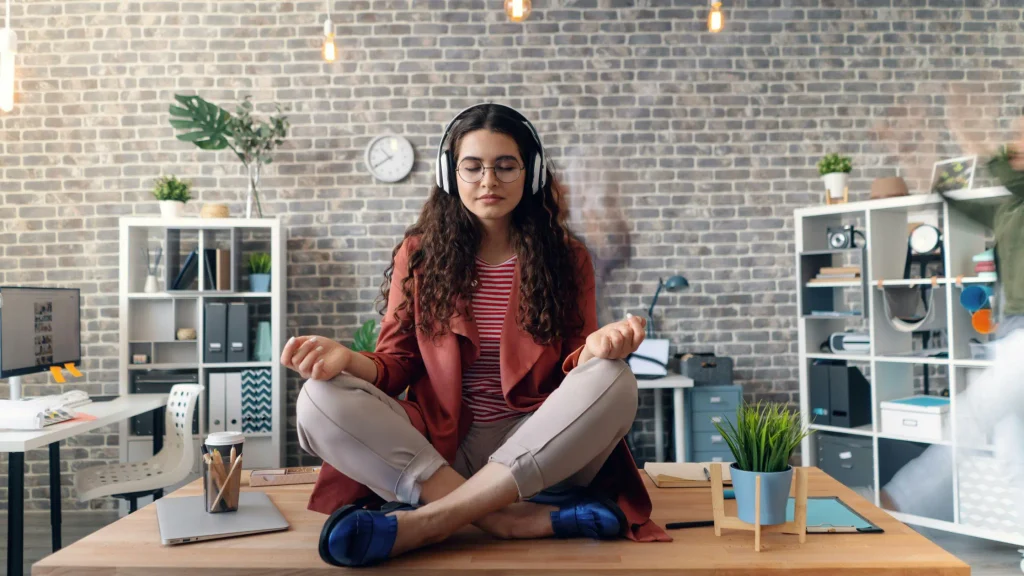
Practical Workplace Meditation Techniques You Can Use Today
To make micro-recovery possible during a packed schedule, choose techniques that match the exact amount of time and privacy you have available.
++ Incorpora posturas con apoyo de pared en tu rutina de yoga en casa.
You can practice each of the following methods sitting upright in your office chair with your eyes open or softly lowered.
1. The 60-Second Physiological Sigh (For Immediate Stress Relief)
When a tense meeting ends or an urgent email arrives, your breathing naturally becomes shallow. A physiological sigh rapidly offloads excess carbon dioxide and slows your heart rate.
- Inhale deeply through your nose until your lungs feel mostly full.
- Without exhaling, take a second, sharp “top-off” inhale through your nose to fully expand the lungs.
- Exhale slowly and completely through your mouth, making the exhale roughly twice as long as the inhale.
- Repeat this cycle three to four times, then return to normal breathing.
2. The 3-Minute Sensory Grounding Scan (For Brain Fog)
When you have read the same paragraph three times without absorbing it, your attention is fragmented.
A rapid sensory scan pulls your awareness out of abstract thoughts and back into your physical environment.
Notice your posture: Place both feet flat on the floor, uncross your legs, and let your shoulders drop away from your ears.
Focus on physical contact: Pay close attention to the pressure of the chair supporting your back and your hands resting on your lap or desk.
Engage your hearing: Spend 60 seconds simply listening to the ambient sounds in the room—such as the hum of an air conditioner or distant keyboard clicks—without judging or labeling them.
Take one deliberate breath: Inhale slowly, exhale fully, and choose the single next task you want to complete.
3. Box Breathing Between Meetings (For Pre-Call Composure)
Used widely in high-stress professions to maintain calm under pressure, box breathing creates a steady, predictable rhythm that stabilizes focus before a presentation or difficult conversation.
- Inhale quietly through your nose for a slow count of four.
- Hold the breath gently at the top for a count of four without clenching your jaw or throat.
- Exhale steadily through your mouth or nose for a count of four.
- Pause with empty lungs for a count of four before starting the next round.
- Complete four full cycles, which takes just over one minute.
How to Build a Sustainable Micro-Recovery Habit at Work
Knowing a meditation technique is helpful, but remembering to use it when you are overwhelmed is the real challenge.
Because stressed brains default to ingrained habits, relying on willpower alone rarely works. Instead, anchor your micro-recovery to triggers that already exist in your daily workflow.
Use transition cues: Commit to taking three slow breaths every time you click “Leave Meeting,” send a major email, or close a browser tab.
Pair with physical routines: Practice a 60-second body scan while waiting for your morning coffee to brew or while your computer restarts.
Set gentle boundaries: Block a five-minute buffer at the end of 30- and 60-minute calendar invites so you have dedicated breathing room before your next commitment.
Mantén expectativas realistas: Do not aim for an empty mind. If your thoughts wander to your to-do list ten times in two minutes, simply noticing the distraction and returning to your breath is a successful repetition.
According to guidance on workplace stress from the Centros para el Control y la Prevención de Enfermedades, organizational factors like workload and scheduling play a major role in employee well-being.
While individual mindfulness practices are powerful tools for managing daily tension, they work best alongside healthy boundaries, realistic workloads, and open communication with managers when demands become unsustainable.
Disclaimer: Workplace meditation and breathing exercises are supportive wellness practices, not substitutes for professional medical or mental health care.
If you experience persistent anxiety, panic symptoms, or chronic burnout, consider consulting a qualified healthcare provider or licensed therapist.
Conclusión
You do not need to overhaul your daily schedule or retreat to a quiet room to protect your focus and energy.
By shifting from long, infrequent breaks to brief, intentional pauses, you can make micro-recovery possible right in the middle of a busy workday.
Start today by picking one natural transition—such as the moment after your next phone or video call—and taking just three slow, deliberate breaths before moving on to your next task.
Preguntas frecuentes
How often should I practice micro-recovery during the workday?
Aim for a brief 60-second to three-minute reset every 60 to 90 minutes, or whenever you transition between major tasks.
Consistent, short pauses throughout the day are generally more effective at preventing cognitive fatigue than a single long break in the afternoon.
Can I meditate at work without closing my eyes?
Yes. In an open office or shared workspace, you can keep your eyes open and rest a soft, unfocused gaze on a neutral spot on your desk, a plant, or the bottom corner of your monitor.
Focusing on physical sensations—like your breath or your feet on the floor—works just as well with your eyes open.
What if breathing exercises make me feel lightheaded or uncomfortable?
If structured counting or holding your breath feels uncomfortable, stop counting and return to your natural breathing rhythm.
You can switch to a non-breath anchor instead, such as noticing the temperature of the air on your skin, relaxing your shoulders, or listening to ambient sounds in the room.
Is two minutes of workplace meditation actually enough to make a difference?
Yes. Two minutes of deliberate breathing or sensory grounding is enough to interrupt a stress response, lower your heart rate, and clear attention residue before starting a new task.
Over weeks and months, these small daily resets build greater resilience against chronic workplace stress.
++ Micromeditaciones que puedes hacer en tu escritorio: 10 prácticas sencillas
++ Why Micro Breaks Should Be Normalized in the Workplace and 5 Ways to Get Started