advertisements
Joint Mapping and Movement Awareness. Movement does not originate in the muscles; it begins in the brain. As we age, a loss of mobility or a hesitant gait is routinely blamed on weakening legs or worn-out cartilage.
Yet, there is something deeply misunderstood about this purely mechanical perspective. The true culprit, more often than not, is the silencing of an invisible communication channel: proprioception.
Integrating somatic practices into the daily lives of older adults is far more than a gentle, low-impact exercise alternative.
It is an urgent neurological necessity. This approach actively reverses chronic sensory degradation, restoring the body’s intrinsic capacity to understand itself in space.
This article explores how reclaiming this internal dialogue rebuilds structural stability and safeguards physical autonomy in our later years.

Table of Contents
- The Anatomy of the Invisible Map
- The Yoga Mat as a Sensory Laboratory
- Metrics of Time: Motor Decline by the Numbers
- Essential Poses for Spatial Reconstruction
- The Silent Revolution of Slowness
- Frequently Asked Questions
- Final Reflections
The Anatomy of the Invisible Map
Every single step taken toward a curb demands an instantaneous, uninterrupted conversation between the periphery of the body and the central nervous system.
Microscopic receptors embedded within tendons, muscles, and joint capsules transmit real-time data regarding angles, pressures, and surface tension.
The brain seamlessly processes this chaotic influx, drawing a vivid, three-dimensional internal blueprint. This is our spatial orientation in full effect.
The passage of time, however, blurs the clarity of this data. Histological studies reveal that biological aging reduces the overall quantity of active muscle spindles while thickening joint capsules, ultimately slowing down the conduction speed of peripheral nerves.
In practice, the brain begins operating with a fuzzy, delayed map of its own structure.
Consequently, many seniors develop the habit of staring fixedly at their own feet while walking, relying on vision to compensate for what the body can no longer feel.
The true danger manifests in the dim light of a midnight hallway. When vision is stripped away, an outdated internal map fails to guide equilibrium, triggering a paralyzing fear of falling.
The Yoga Mat as a Sensory Laboratory
Bodywork focused on proprioception operates essentially as a process of neurological literacy. Conventional strength training often isolates muscles along rigid, linear trajectories, entirely bypassing the complex nuances of sensory integration.
Yoga charts the exact opposite course, demanding multi-planar coordination, isometric stabilization, and a state of continuous mindfulness distributed throughout the entire skeleton.
By sustaining a shape and minutely adjusting weight distribution, the practitioner reactivates dormant neural pathways.
Shifting pressure from the heel to the outer edge of the foot, for instance, triggers immediate reflex corrections in the pelvis and spine.
This subtle refinement elevates joint mapping and movement awareness within a truly therapeutic framework.
With consistent practice, the cortical representation of each joint gains sharp definition within the motor cortex. Clinically, this translates to a measurable reduction in joint position sense error.
Because neuroplasticity does not come with an expiration date, the nervous system retains the capacity to optimize biological data processing at any stage of life.

Metrics of Time: Motor Decline by the Numbers
Tracking the exact tempo of this sensorimotor deceleration allows for the design of far more effective, targeted preventative interventions.
Cross-sectional data consolidated by the National Institutes of Health (.gov) illustrates the linear precision losses that accompany biological aging when the body is left on autopilot.
| Biomechanical Indicator | Annual Rate of Chronological Change | Direct Impact on Daily Autonomy |
| Nervous System Response Time | Delayed by 1.2 to 1.3 milliseconds per year | Sluggish muscular reactions when encountering unexpected trips or uneven ground |
| Movement Execution Duration | Increased by 2.3 to 4.3 milliseconds per year | Elevated energy expenditure and early fatigue during routine walking |
| Absolute Spatial Precision | Reduced by 0.02° to 0.04° per year | Trajectory deviations and a higher probability of bumping into surrounding objects |
| Joint Position Sense Error | Sharp, exponential increase after age 65 | Chronic loss of limbs’ alignment awareness without relying on direct visual confirmation |
Essential Poses for Spatial Reconstruction
To effectively reorganize internal coordinates, the best strategy involves introducing asymmetrical poses that challenge equilibrium under controlled conditions, utilizing intelligent structural supports.
Mountain Pose initiates this process of deep listening. Within this posture, older adults learn to lift their toes, spread them wide, and return weight to the earth equitably, firmly anchoring tactile perception at the base of support.
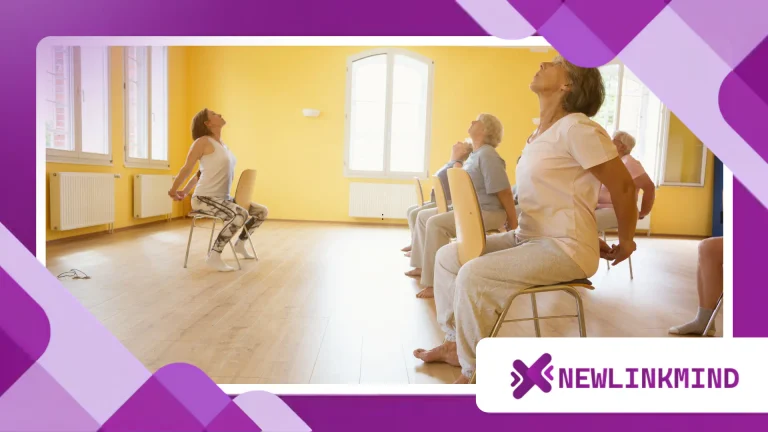
Tree Pose challenges unilateral balance with greater intensity. Utilizing a wall or a stable chair back removes the panic of falling, allowing the practitioner to safely investigate the micro-movements of the ankle that maintain upright posture.
This controlled sway is the brain actively relearning how to stabilize its foundation in real time.
Warrior II amplifies this cognitive demand by requiring simultaneous attention in opposing directions. While the front knee must align precisely over the second toe, the back arm extends completely outside the field of vision.
Managing these conflicting spatial demands forces the nervous system to track the body’s periphery without visual assistance.

The Silent Revolution of Slowness: Joint Mapping and Movement Awareness
Rapid movements depend heavily on automated, pre-recorded motor loops that bypass real-time sensory feedback loops entirely.
When a senior moves with haste, they rush straight through their zones of sensory deficit, falling back on old compensatory habits that overload vulnerable, worn joints.
Decelerating transitions forces the nervous system to process incoming data dynamically at every single inch of displacement.
This conscious deceleration gives the brain the necessary time to detect discrepancies between the intended trajectory and the actual position of the limb.
Moving at a paused tempo preferentially recruits slow-twitch muscle fibers, which happen to be densely populated by proprioceptive muscle spindles.
Moving slowly effectively transforms physical exercise into a profound session of neurological reprogramming.
There is an equally invaluable psychological benefit: predictability breeds confidence, effectively dismantling the psychological cycle of fear associated with falling.
When a practitioner realizes they command every fraction of a second of a physical transition, the nervous system dampens its internal stress alerts. Free from defensive tension, muscles release, and joints naturally reclaim their organic range of motion.
Frequently Asked Questions
What does joint mapping mean for an older adult’s routine?
It refers to sharpening the precision with which the brain locates various body parts in space. This process improves the recognition of joint angles without requiring the individual to look down at their arms or legs to verify their positioning.
What is the ideal weekly frequency for balance training?
Sessions lasting twenty to thirty minutes, practiced two to three times a week, offer an ideal stimulus for neural adaptation. Consistency and the quality of focused attention matter infinitely more than physical exhaustion.
Can somatic movements help prevent domestic falls?
Yes. By decreasing joint positioning errors, older adults regain the ability to react quickly and accurately to slippery rugs or uneven surfaces, activating the correct stabilizing muscles before a minor stumble escalates into a dangerous fall.
Final Reflections
Exercising bodily perception is an indispensable pathway for preserving physical dignity over a lifespan.
Stepping away from a performance-driven mindset to focus on the quality of internal dialogue allows us to actively mitigate the neurological effects of aging.
This subtle dedication reconstructs the internal maps of our architecture, granting us steady, grounded steps to walk confidently through the world.
Practicing in a welcoming environment, under the guidance of professionals who intimately understand functional biomechanics, significantly amplifies these physical rewards.
Dedicating time to this learning process ultimately protects the freedom of independent mobility.
To deepen your understanding of physical activity guidelines tailored for longevity, explore the health frameworks provided by the Centers for Disease Control and Prevention (.gov).
++ Gentle Yoga for Seniors: 10 Poses to Try
++ Joint Relief: 6 Free Chair Yoga For Seniors Classes To Reduce Stiffness